


Private equity’s relationship with artificial intelligence is changing.
AI was initially treated as a technology opportunity. Now, it is increasingly being viewed as a value creation and investment question.
That shift is becoming particularly important in the UK. The Forvis Mazars UK Private Equity Report 2026 found that technology is the leading sector targeted by UK private equity investors, with 69% identifying it as a focus area. The report also highlights a broader shift towards value creation, operational influence and tighter execution.
The implication is significant.
Private equity firms are no longer asking simply whether their portfolio companies should adopt AI.
They are asking whether AI can change the economics of the business.
Jump to
- The AI Investment Thesis Is Changing
- From AI Adoption to Value Creation
- Why Portfolio Companies Need a Different Approach
- Three Areas Where AI Can Create Enterprise Value
- AI Is Also Becoming an Investment Risk
- Why Execution Speed Matters
- What Fliweel Sees in Practice
- The New AI Question for Private Equity
The AI Investment Thesis Is Changing
The first phase of enterprise AI adoption was largely about experimentation.
Employees were given access to generative AI tools. Teams experimented with ChatGPT and Copilot. Enterprises and Growth companies tested automated content creation, research, customer support and internal knowledge tools.
For investment teams, the potential value appeared obvious.
If AI could help employees complete tasks faster, portfolio companies could reduce costs and improve productivity.
But productivity alone is not necessarily a compelling investment thesis.
Recent research from McKinsey illustrates why. Its analysis of 471 private equity-backed companies found that companies broadly embracing AI had median revenue multiples approximately 130% higher than companies using AI more opportunistically. McKinsey’s research also found that companies progressing towards deeper AI integration, including embedding AI into products and building new businesses, showed stronger value creation outcomes.

The lesson is not that every portfolio company should become an AI company.
It is that the greatest opportunity may sit beyond simple automation.
AI can reduce costs, but it can also increase capacity, improve customer acquisition, strengthen services and create entirely new commercial opportunities.
That changes the investment case.
From AI Adoption to Value Creation
There is a useful parallel with the way private equity itself has evolved.
Value creation was once heavily associated with financial structuring and multiple expansion. Today, leading firms increasingly rely on operational capabilities, specialist expertise and structured value creation plans.
AI is becoming another layer of that operating model.
Owning a portfolio company that uses AI is not the same as owning a portfolio company that has been redesigned around AI.
The distinction matters.
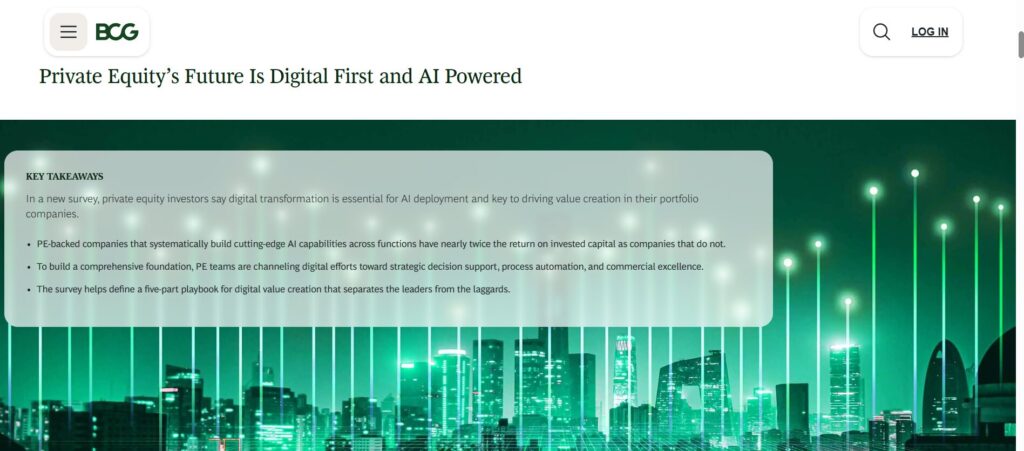
BCG’s 2026 research found that private equity investors increasingly view digital transformation as an essential foundation for AI deployment and value creation. Its survey of 100 senior PE investors found that nearly 30% now integrate digital levers into diligence, while another 57% consider them core to value creation planning. BCG also found that PE-backed companies systematically building advanced AI capabilities across functions had nearly twice the return on invested capital of companies that did not.
This points towards a different way of thinking about AI investment.
The question should not be:
“Where can we deploy an AI tool?”
It should be:
“Where can AI materially improve the performance of this portfolio company?”
That could mean improving margins.
It could mean accelerating revenue.
It could mean increasing capacity without increasing headcount at the same rate.
Or it could mean protecting the business from an emerging competitive threat.
Why Portfolio Companies Need a Different Approach
For UK private equity firms, the challenge is that every portfolio company is different.
A technology business may have opportunities to embed AI directly into its product.
A professional services business may benefit from AI-assisted research, document processing and client delivery.
An industrial business may have opportunities in forecasting, operational reporting and process optimisation.
An Enterprise or Growth company may simply need to remove the manual processes that are beginning to limit its ability to scale.
That means a portfolio-wide AI strategy should not start with a list of tools.
It should start with the value creation plan.
Start with the economics
If the investment thesis is margin improvement, identify the workflows that have the greatest effect on cost.
If the thesis is revenue growth, look at sales, customer acquisition, retention and service capacity.
If the thesis is international expansion, consider where AI can help teams operate across markets without creating equivalent increases in administrative overhead.
AI should be connected directly to the commercial objective.
Prioritise the highest-value processes
Not every process deserves an AI project.
The strongest candidates usually combine a meaningful amount of manual work with measurable business impact.
This could include:
- Finance and invoice processing
- Customer and client communications
- Internal knowledge retrieval
- Operational reporting
- Employee onboarding
- CRM and sales administration
- Data processing and analysis
The objective is not to automate everything.
It is to find the processes where improvement can make a measurable difference to the business.
Build around existing systems
For Enterprises and Growth companies, AI adoption does not necessarily require replacing the existing technology stack.
In many cases, the opportunity is to connect AI to the systems the organisation already uses.
That can reduce implementation risk and make it easier for management teams to see results quickly.
Three Areas Where AI Can Create Enterprise Value
1. Margin expansion
Automation remains one of the clearest opportunities.
AI can reduce the amount of manual work required for finance, reporting, document processing, customer communications and administrative workflows.
But the real value is not simply the number of hours saved.
The bigger question is what the organisation can do with the capacity that has been released.
Employees can spend more time with customers.
Finance teams can focus on analysis rather than administration.
Management can spend less time compiling information and more time making decisions.
That is where productivity becomes an operating advantage.
2. Revenue growth
AI can also influence the top line.
Sales teams can use AI to improve CRM data, qualify opportunities and automate follow-up.
Customer-facing teams can respond faster and handle greater volumes.
Enterprises can use their internal knowledge and data to develop new services or improve existing ones.
For a private equity investor, this matters because revenue growth can create a much larger value opportunity than cost reduction alone.
3. Scalability
Growth can become expensive when every increase in revenue requires a proportional increase in headcount.
AI can change that equation.
If a Growth company can process more enquiries, invoices, reports or customer requests without increasing administrative capacity at the same rate, it can scale more efficiently.
That creates operating leverage.
And operating leverage is precisely the type of improvement that can strengthen an investment thesis.
AI Is Also Becoming an Investment Risk
There is another side to the equation.
AI is not only an opportunity for portfolio companies.
It can also threaten existing business models.
Private equity firms therefore need to consider AI exposure during diligence, not simply after acquisition.
A business whose core service relies heavily on repeatable information processing may face a different competitive landscape from a company with proprietary data, specialised expertise, physical infrastructure or strong customer relationships.
This creates a new set of questions for investment teams:
Could AI make this company more competitive?
Could AI make a competitor more competitive?
Could AI materially reduce the cost of delivering the company’s core service?
Could an AI-native competitor offer a similar service at a fundamentally different price?
Does the company have proprietary data, expertise or intellectual property that could become more valuable as AI develops?
AI therefore needs to be considered as both a value creation opportunity and a potential source of disruption.
Why Execution Speed Matters
The technology is developing quickly.
That creates a problem for traditional transformation programmes.
An organisation can spend months developing a strategy, approving a major technology programme and selecting platforms while the underlying technology continues to change.
For private equity, that can be particularly costly.
The investment period is finite.
Value creation initiatives need to demonstrate progress.
This is why Fliweel’s approach focuses on practical deployment rather than lengthy AI strategy exercises.
Its 6-Week AI Sprint is designed around identifying a high-impact process, developing a working AI solution and measuring the outcome against agreed KPIs.
The principle is simple:
Test the value before scaling the investment.
For PE operating teams, this creates a more disciplined way to approach AI.
Identify the opportunity.
Build the solution.
Measure the outcome.
Then decide whether it deserves to scale across the company or portfolio.
What Fliweel Sees in Practice
This approach is already producing measurable results.
Fliweel worked with Infinite Equity, a global business handling invoices for more than 100 clients per month. Its previous invoice process was manual, slow and increasingly difficult to scale.
Fliweel analysed the existing process, supported the CRM migration and implemented integrations to automate invoice processing.
The result was a reduction in invoice processing time from seven business days to three to four business days.
That example illustrates an important point about AI investment.
The value is not the technology itself.
The value is what changes in the business because the technology has been implemented.
In this case, the result was a faster operational process that could better support a growing business.
That is a much stronger investment conversation than simply saying that a company has “adopted AI”.
The New AI Question for Private Equity
The AI investment thesis is not disappearing.
It is becoming more disciplined.
The first question was:
“Where should we use AI?”
The better question is now:
“Where can AI create measurable enterprise value?”
For UK private equity firms, that means looking at AI across the entire ownership lifecycle.
During diligence, investors need to understand AI exposure and opportunity.
During the value creation phase, operating teams need to identify the highest-impact use cases.
During ownership, management teams need to measure whether those initiatives are actually improving performance.
And ahead of exit, the business needs to demonstrate that its AI capabilities represent a genuine competitive advantage rather than a collection of disconnected experiments.
For Enterprises and Growth companies, this creates an important opportunity.
The winners will not necessarily be the organisations that deploy the most AI.
They will be the organisations that identify where AI can fundamentally improve how the business operates, prove the impact and scale what works.
For private equity, that may be the real shift in the investment thesis.
AI is moving from a technology line item to a value creation capability.
The question for investment teams is no longer whether AI belongs in the portfolio.
It is:
Which companies can use AI to create the most defensible value, and how quickly can that value be proven?
ABOUT FLIWEEL.TECH
Fliweel.tech is a leading provider of AI and automation solutions, specialising in intelligent bot development and robotic process automation. Our mission is to help businesses streamline their operations, reduce errors, and focus on higher-value tasks through innovative technology. With a commitment to excellence and customer satisfaction, Fliweel.tech delivers customised solutions that drive tangible results for clients across various industries.

