


AI adoption in UK businesses has almost tripled since late 2023, reaching around 35% of businesses with 10 or more employees in June 2026, according to the Office for National Statistics (ONS). The figure comes from the Business Insights and Conditions Survey and measures businesses reporting that they use at least one AI technology.
That 35% figure is significant, but it does not mean one in three businesses has transformed its operations with AI. ONS data shows that the average number of AI technologies used per adopting business has increased only modestly, while just 10% of AI-using businesses reported using AI extensively.
So what does the latest evidence actually tell us about AI adoption in the UK?
Jump to
- AI adoption is accelerating
- Why do different studies report different AI adoption rates?
- Does using an AI assistant mean a business is AI mature?
- The productivity case is becoming clearer
- AI adoption does not automatically mean job losses
- The adoption gap is still real
- What UK businesses should do next
AI adoption is accelerating
The clearest trend in the latest ONS data is the speed of change.
In September 2023, around 12% of UK businesses with 10 or more employees reported using at least one AI technology. By June 2026, that figure had risen to around 35%, almost three times the original level.
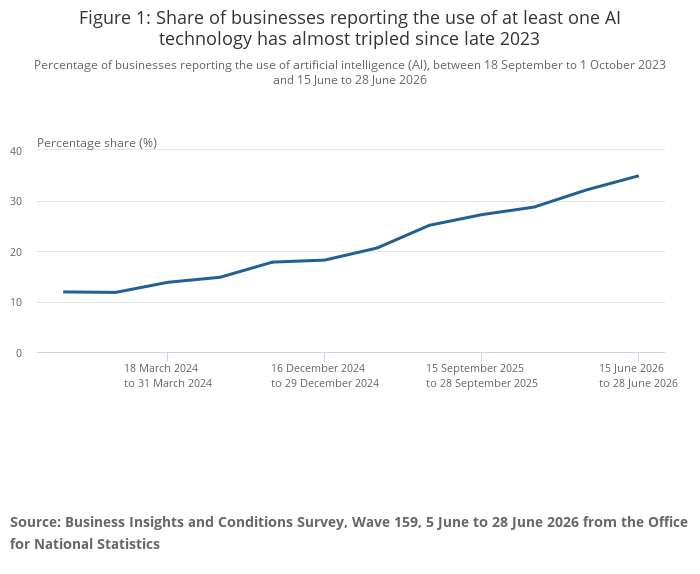
The increase shows that AI has moved beyond a relatively small group of early adopters.
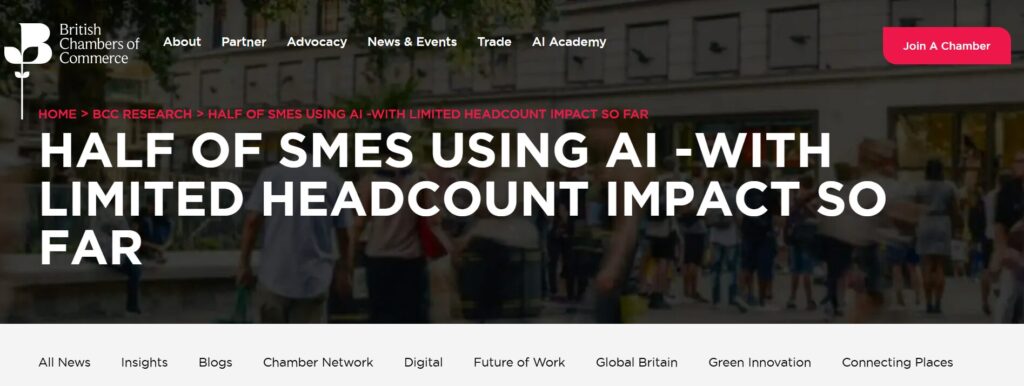
The picture is also supported by the British Chambers of Commerce (BCC). Its March 2026 research found that 54% of UK firms were actively using AI, compared with 35% in its previous year’s research.
Why do different studies report different AI adoption rates?
Because they measure different things. The ONS figure covers businesses with 10 or more employees and asks whether they use at least one AI technology. Other studies can use different business populations and survey questions.
The important takeaway is the direction of travel: multiple sources show that AI adoption across UK businesses is increasing.
Large businesses are moving faster
AI adoption is not evenly distributed across the UK economy.
The latest ONS data shows that 28% of businesses with fewer than 10 employees reported using at least one AI technology, compared with 49% of businesses with 250 or more employees.
Government research from the Department for Science, Innovation and Technology (DSIT) shows a similar size-based pattern. Its 2026 research found that 36% of large businesses and 23% of mid-sized businesses were using at least one AI technology, compared with 14% of micro businesses.
The figures come from different studies, so they should not be combined into one dataset. But both point towards the same structural pattern: larger organisations are generally further along the AI adoption curve.
For enterprises and growth companies, the issue is therefore shifting from access to AI tools towards implementation.
AI is mainly improving existing operations
The latest data also challenges the idea that businesses are primarily using AI to create entirely new products or business models.
According to ONS, improving existing business operations is the most common purpose for AI adoption, reported by around three fifths of businesses using AI.
Larger organisations tend to focus particularly on efficiency, while smaller businesses report using AI across a wider range of activities, including expansion and innovation.
Does using an AI assistant mean a business is AI mature?
No. Using an AI tool is one indicator of adoption, but it does not necessarily demonstrate AI maturity.
A more mature approach involves identifying valuable use cases, integrating AI with existing systems, establishing appropriate governance and measuring the resulting business impact.
That distinction is becoming increasingly important as adoption grows.
The productivity case is becoming clearer
Businesses are not adopting AI simply because the technology is available. Increasingly, the focus is on productivity and operational efficiency.
The DSIT’s 2026 AI Adoption Research found that increasing efficiency and productivity was the most commonly cited motivation for businesses adopting or expanding AI.
The ONS research supports this pattern, showing that improving business operations is the most common reported purpose for AI adoption.
This suggests that the strongest immediate opportunities may not come from completely reinventing a business. They may come from identifying expensive, repetitive or slow processes and improving them.
What is holding businesses back?
The challenge is not always the technology itself.
Earlier ONS research found that difficulty identifying suitable activities or use cases was a leading barrier to AI adoption, alongside cost and a lack of AI expertise.
That is an important distinction. Businesses may have access to powerful AI tools but still struggle to determine where those tools can create measurable commercial value.
AI adoption does not automatically mean job losses
One of the most persistent concerns around AI is whether adoption automatically leads to fewer employees.
The latest evidence is more nuanced.
ONS reports that most businesses adopting AI reported no change in workforce headcount. Among businesses using AI to improve business operations, around 6% reported a decrease in headcount.
The BCC found a similar pattern. Its March 2026 research reported that 95% of SMEs using AI said it had no impact on workforce size over the previous year, while 86% said job roles had remained unchanged.
These findings do not mean AI will have no effect on employment. They suggest that, so far, adoption is more commonly associated with changing tasks and workflows than with immediate large-scale workforce reductions.
ONS also found that training or retraining existing employees is the most commonly reported way businesses are integrating AI skills into their workforce.
The adoption gap is still real
Despite rapid growth, a substantial proportion of UK businesses remain at an early stage.
DSIT’s 2026 research found that 16% of businesses were currently using at least one AI technology, while another 5% planned to adopt AI. 80% reported that they neither used AI nor had plans to adopt it at the time of the research.
At first glance, this appears to conflict with the ONS figure of 35%.
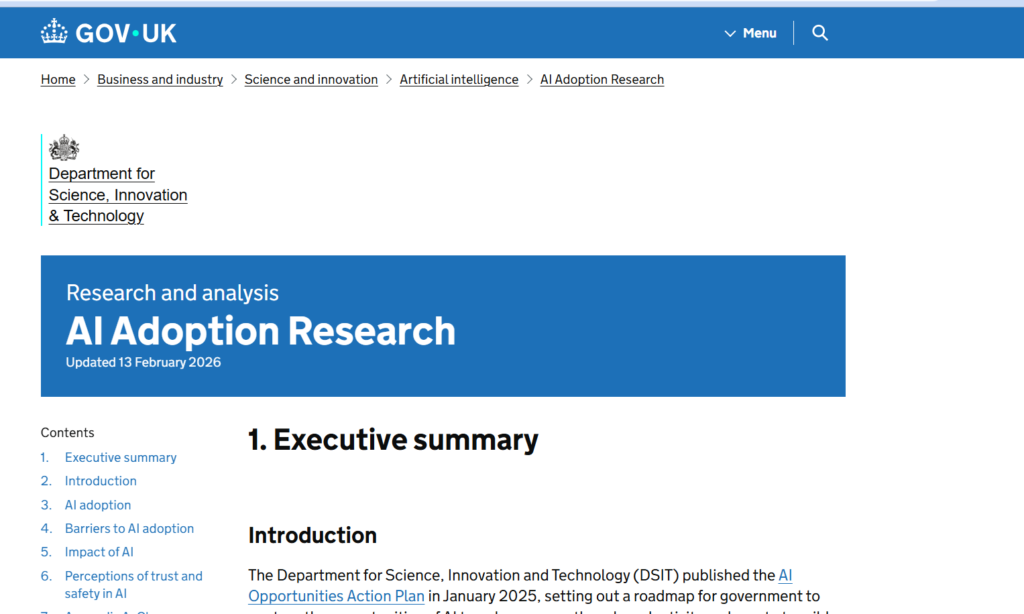
It does not necessarily indicate an error. The studies use different methodologies, samples and definitions of AI adoption.
This is precisely why AI statistics should always be read alongside the methodology behind them.
The consistent message is clear: adoption is rising, but the depth and maturity of adoption remain uneven.
What UK businesses should do next
The data suggests that the next stage of AI adoption will not simply be about adding more AI tools.
It will be about finding the processes where AI and automation can produce measurable improvements.
For enterprises and growth companies, a practical starting point is to identify one high-cost, repetitive or slow process. This could include invoice processing, customer enquiries, document handling, reporting, recruitment administration or data entry.
Then establish a baseline.
How long does the process take? How many people are involved? Where do errors occur? What systems are already being used? What would a meaningful improvement look like?
This is where implementation matters.
Fliweel’s 6-Week AI Sprint is designed around a specific process problem. The programme starts with a discovery workshop, assesses safety and governance requirements, then moves through design, build, testing and deployment over six weeks, with outcomes measured against pre-agreed KPIs.
For organisations where AI is a longer-term strategic priority, Fliweel’s Trusted AI Partner programme provides a 12-month approach covering four AI Sprints, strategy sessions, governance, deployment, user enablement and business impact measurement.
Ready to move from AI experimentation to measurable results?
If your business has a manual process that is costing time, money or capacity, Fliweel can help identify where AI and automation can make the biggest difference.
Book a free discovery call with Fliweel to identify your highest-impact opportunity and explore a practical path to deployment.
Book Your Free AI Discovery Call →
The latest UK data tells a clear story: AI adoption is accelerating, but adoption alone is not the same as transformation.
The businesses most likely to benefit are those that move beyond experimenting with individual tools and start redesigning specific processes around measurable outcomes.
The question for UK businesses is no longer simply, “Are we using AI?” It is, “Where can AI make a measurable difference to how we operate?”
ABOUT FLIWEEL.TECH
Fliweel.tech is a leading provider of AI and automation solutions, specialising in intelligent bot development and robotic process automation. Our mission is to help businesses streamline their operations, reduce errors, and focus on higher-value tasks through innovative technology. With a commitment to excellence and customer satisfaction, Fliweel.tech delivers customised solutions that drive tangible results for clients across various industries.

